Your Deleted Signal Messages Were Never Really Gone, But Apple's Latest Update Fixed That | April 27
Apple patched a bug hiding in your notifications, Australia's teen social media ban shows enforcement is harder than legislation, and Firefox gets a privacy upgrade it didn't tell anyone about.


On Our Radar 🎯
The iPhone Bug That Turned "Disappearing" Messages Into a Paper Trail
As we covered in our last newsletter, it was revealed that notifications displaying message content were being cached on the device, even after the original messages had been deleted or auto-expired. Because of this, forensic tools used by police were able to extract the contents of Signal messages users believed were gone.
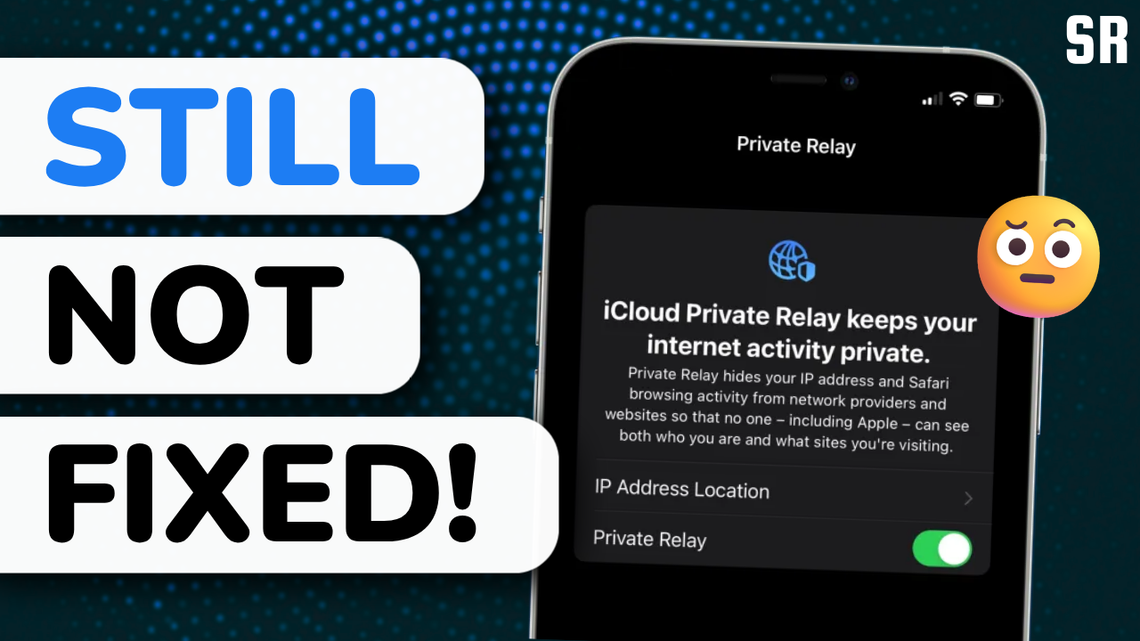
Apple has now patched this issue on iPadOS & iOS 26.4.2. This means for any of you worried about this problem, all you need to do is update your Apple devices, and it will even retroactively apply to old messages before the update.
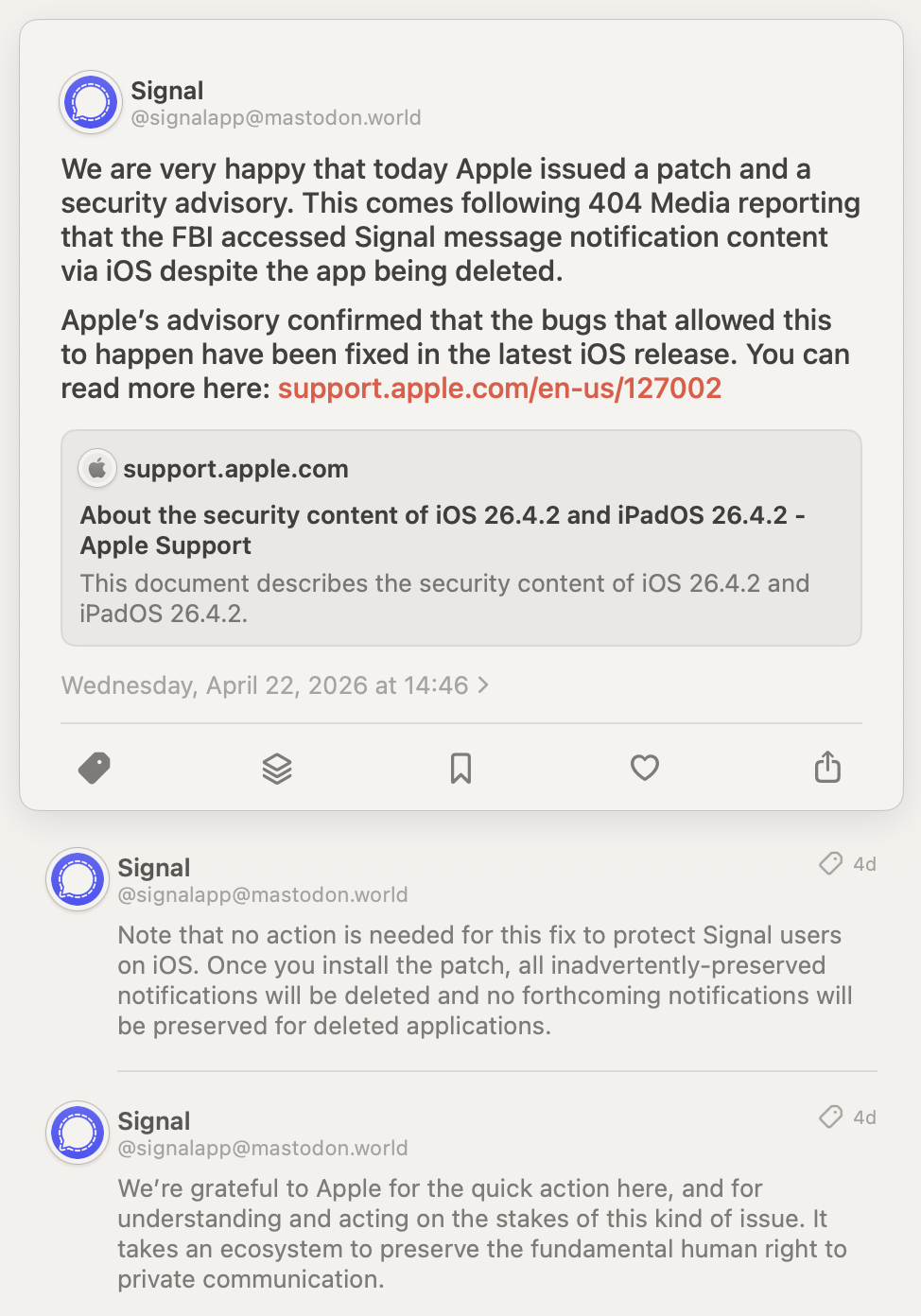
What you can do: Update your iPhone or iPad to the latest iOS/iPadOS version immediately if you haven't already. I'm seeing reports this security update is available as iOS 18.7.8 as well, so for those on older devices you still have a path forward. Do it in: Settings → General → Software Update
Bits & Bytes 🤖
~ X Officially Launches X Chat
X has spun off its direct messaging feature into a dedicated standalone app called X Chat. The move mirrors what Meta did with Messenger by separating DMs from the main platform experience. The launch has raised eyebrows for reportedly overstating the app's security features, positioning it with language that implies private or encrypted messaging without the substance to back it up.
Our take: A messaging app from one of the world's most surveillance-adjacent social platforms deserves skepticism. X has a track record of questionable security practices, and actively spreads disinformation about its (safer) competitors. Because of this, it's hard for us to even get an accurate, realistic read on its security claims. So until there's better clarity around its policies and we get a better assessment on its real protection, proceed at your own risk. If you're looking for a private messenger, the options haven't changed.
~ 60%+ of Australian Kids Still Using Social Media Despite the Ban
Australia's under-16 social media ban has been in force for months, and this new research shows it isn't working as intended. A poll found that over 60% of those who had accounts before the ban still have access to at least one restricted platform. TikTok, YouTube, and Instagram each retained over half of their pre-ban child users.
Our take: We've said it before and we'll say it again: Outright bans of these services aren't likely to make kids safer. It just makes policymakers look responsive. Real child safety online requires accountability mechanisms with teeth. These social media bans ignore the real, addictive issues of social media, and do children (and adults!) a disservice. We hope the Australian government reconsiders their approach, and that other countries see what the reality of these bans actually looks like.
~ Colorado's Age Verification Bill Carves Out Open Source
Colorado's SB51 age-attestation bill, which would require OS providers and app stores to supply an age-related signal so apps can identify minors has moved forward from a House committee with a significant new amendment. The updated language explicitly exempts open-source operating systems, applications, code repositories, and containerized software distributions!
Our take: This is an amazing development and worth watching as a model for other states. The fact that Colorado's legislature responded to advocacy here, and wrote the exemption broadly enough to cover the ecosystem without naming specific projects shows that technical community engagement in policy processes actually works. Huge shoutout to System76 as they seem to have been a major part of making this happen—let them be a testament that communicating with politicians and making your voice heard is not useless! This can be replicated!
This Week on Techlore 📺
Lots of fun updates these last 1-2 weeks for services many people in the community love. We had Tuta launch their new E2EE cloud service in private beta, I broke down my thoughts in an initial review:
Tuta Drive First Look: The Encrypted Platform That Does What Google and Apple Won’t
Tuta just launched their encrypted cloud storage in closed beta, completing a compelling zero-knowledge workspace with email, calendar, contacts, and drive. Here’s my first look at what’s there, what’s missing, and why this is bigger than just another cloud provider.
 Henry Fisher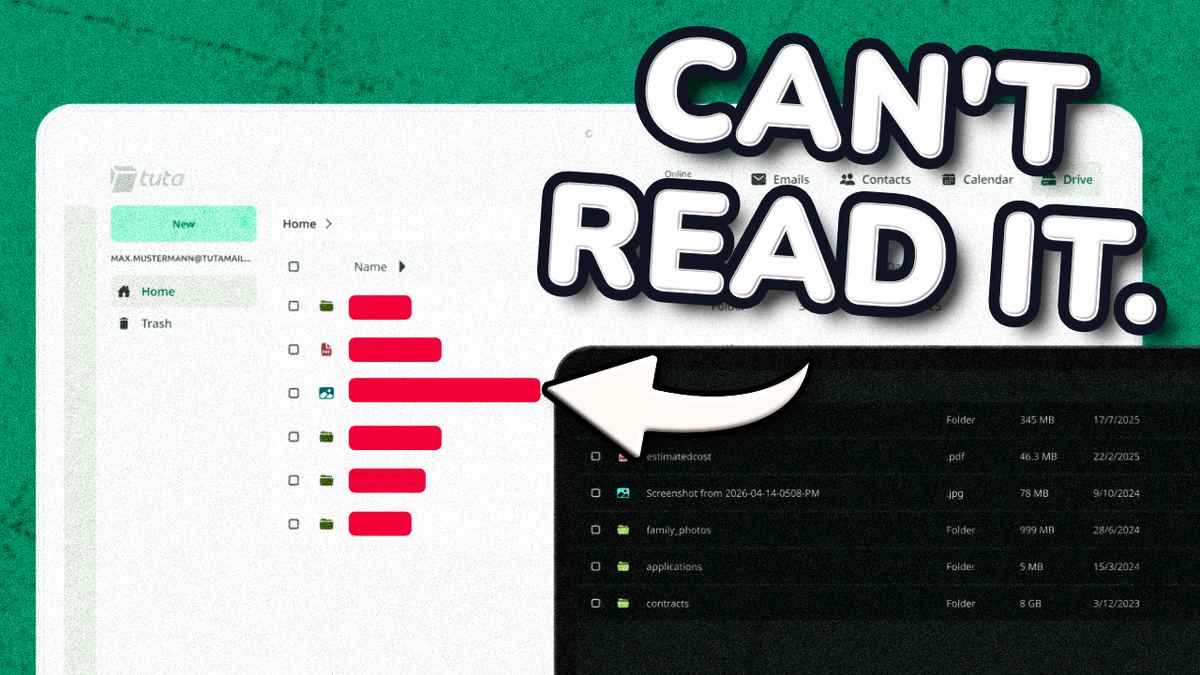
Brave launched a paid, out-of-the-box debloated experience of their browser called Brave Origin—my full review:
Brave Origin Review: Is the New $60 Paid Browser Worth It?
Brave just launched Brave Origin. A paid, stripped-down browser with no AI, no crypto wallet, and no telemetry. I paid $60 to test it so you know what to expect.
Henry Fisher
After the Brave Origin review went live, our inbox lit up with so many of you asking for me to take a look at Helium browser, so we made it happen:
Helium Browser Review: Is This Minimal, Privacy-Focused Chromium Browser Worth Switching To?
Helium Browser promises a privacy-respecting Chromium experience with no cryptocurrency, no AI, and no bloat. Here’s what I think after testing it head-to-head against Brave.
Henry Fisher
On Techlore Talks we've been lucky to have such incredible guests! We had a legal expert from the Free Software Foundation of Europe join us to chat about age verification, Bitwarden came to speak about password management, and we brought on Mozilla to see what their vision is for their new AI tools...and the controversy surrounding them.
Age Verification Laws and Free Software: A Legal Expert Tells Us What’s Actually at Stake
Techlore Talks brings you in-depth conversations with the experts at the forefront of digital rights, privacy and security.
Henry Fisher
Password Manager Security Explained: Argon2, PBKDF2, and Open Source with Bitwarden
Techlore Talks brings you in-depth conversations with the experts at the forefront of digital rights, privacy and security.
Henry Fisher
Is Firefox AI Private? Mozilla’s VP of Product on AI Opt-Out Controls, Smart Window, and Having a Seat at the Table
Techlore Talks brings you in-depth conversations with the experts at the forefront of digital rights, privacy and security.
Tori
Finally, I made a video recapping the latest age verification laws in the EU and the US:
EU and US Age Verification Explained: What the ‘Parent’s Decide Act’ and EU Apps Actually Mean for Privacy & Freedom
This week, the US introduced a federal bill to put age verification directly into your operating system, and the EU launched an app to do the same thing using cryptography. Let’s break down exactly what each one does and why both have long-term implications that go far beyond protecting kids.
Henry Fisher
Action Item ✅
Open your iPhone or iPad and update to the latest iOS right now. The patch Apple just released closes a real hole that was being exploited. Settings → General → Software Update
Written by

Get Ahead of the Snoops with Surveillance Report
Surveillance Report: what matters in privacy, security, and digital rights. Weekly, free.